
Respairing
...fresh hope after despair

A couple of nights ago, a 19-year-old man broke into a synagogue in my hometown, doused the place in gasoline, and set it on fire. He bragged about it and texted a family member proof of his horrific actions before being arrested, after his father turned him in to proper authorities.
When I first learned about the arson and saw pictures of the destruction, my mind did one of those crazy timewarp loops of the times I have been at the Beth Israel Congregation and the Institute of Southern Jewish Life, which is housed there. Or WAS housed there. And WILL BE there again. Those are other posts for another day. Suffice it to say this place and these people have been strong and solid defenders of and advocates for the least of these and the poor and tired and huddled masses, yearning to be free.
Then my mind switched to the people I know who have worked and worshiped there. Ava. Johnny. Linda. Lauren and her young child.
Then there’s Vanessa, who has spent the past decade podcasting and Zooming and teaching from a place where having four grandparents who were concentration camp survivors during the Holocaust has framed so much of her identity as a cultural/non-religious Jew. She has never been to Mississippi, but this story would wound her soul if she learned about it.
I began to remember the writers and storytellers - some with direct ties to Beth Israel, others not really, yet the connective tissues run deep. People who have shared their stories of pain that show threads of resilience and hope regardless. People like Catherine, Beth, Katy, and Corrie.
Ruth. Hannah. Mary.
I have mourned from the comfort of my home as those most directly affected gathered around ashes and lit candles in safe spaces. Displaced for now, yet bound by community. Exchanging beauty for ashes - or at least bearing witness to the destruction and chaos.
I have lamented, once again internalizing sorrow and shame by what people who look like me and religiously identify like I do have done in the name of ignorant reverence and platitudes.
Earlier today, a Mississippi-based online magazine with politically conservative leanings put out a story about the arsonist, who lives about five or so miles from the synagogue, as the bird flies. I should have read the article, gotten some basic information, and stopped there. There wasn’t any underlying sympathy in the words, but it did stop short of hyperbolic vitriol. I decided to check out the comments for the article on their social media site.
Big mistake. Huge.
As per usual - and why I can no longer hang out in those spaces – the meanness and cruelty was as thick and palpable as dragging a stick through a Mississippi creek.
It took me back to another Mississippi travesty, this one in 2011. Highway 80 at Ellis Avenue. Right down the street from the church my Itty Bitty Baptist Church van would travel to once a year for state Bible Drills, and then stopping at Po Folks for lunch before heading back home. Within eyesight of the defunct - but still much beloved and long lamented by my father - Dog ‘N Suds. Right next door to the Ellis Avenue sniper incident of 1996. Up the road from the Green Stamp redemption store, where my mom got some dark maroon hurricane lamps a few years after Hurricane Camille hit the coast. She still has them…
Back then, I wrote these words on my mom/sociology blog and shared with my Facebook friends:
Today I found out about a story that happened just a few miles down the road from where I grew up. A couple of months ago, a 49-year-old black man named James Craig Anderson was killed in what was assumed to be a hit and run accident. Well, it turns out that two truck loads of drunk teenagers purposely drove one county over, with the expressed intention of ‘messing with a n*****’.’ It was all captured on a security camera, and is absolutely gruesome and heart-breaking to watch. Based on witness accounts, there is absolutely no doubt that it was completely racially related.
How in the world is this still happening? And, what can be done to stop it? I want to tell his family that no, this is not how all white people are. We do not sit around in the privacy of our homes and call people horrible names. We don’t secretly wish that we could go out and do the same thing. Our hearts break that this happened. At least mine did.
No wonder the rest of the world still considers Mississippi an ignorant, third-world hell hole. It really isn’t. Tragically, however, some people still perpetuate that stereotype with their horrible actions. I want to do all I can to shatter those stereotypes and make my world a better place, where people truly are judged not by the color of their skin, but by the content of their character.
And then a few days later:
I went to a prayer vigil/walk for James Craig Anderson tonight. My husband and two youngest kids were with me. And so were hundreds of other people. As we were walking down a main street in Jackson, singing ‘We Shall Overcome,’ I was struck by the sadness of the situation. Why in the world are we still dealing with this mess? I know racism is about as old as mankind itself, so I don’t know if there will ever be a lasting solution. I do know that I don’t want to be part of the problem.
What that looks like exactly, I don’t know. I’m pretty sure I’ll be fleshing it out here, though.
“All that is necessary for evil to triumph is for good men to do nothing”--Edmund Burke
I hit that send/post button, and naively thought I was providing a space where people could express their solidarity, or at least sympathetic emojis. I was mistaken. There was nothing ugly like I saw on that Facebook page this morning about Beth Israel, but it was pretty much crickets. If people felt anything for this man, his family, or our community, they kept it close to the vest.
Shortly after, I left Facebook for the second or third time, only to leave for good in 2020 when I got some snarky comments after I posted a selfie with my cute Gilmore Girls/Luke’s Diner facemask. A bridge too far, my friends. A bridge too far. 🙂
I have thought about this synagogue and this heinous act quite a bit over the past couple of days. I did not capture my thoughts on paper, but Lauren did. She is an actual member of the Beth Israel community, and posted some beautiful reflections at Rooted Magazine.
That evening, I learned that the fire was not started by a candle or a random electrical fire; it was arson. A man we now know to be the pimply and hateful nineteen-year-old Madison resident Stephen Spencer Pittman broke into my synagogue with an ax and set it on fire. There’s a video of him online now, his face covered with a mask, dousing the Beth Israel lobby with gasoline. I’m not sure how Pittman came to believe our small congregation of 150 families was the “synagogue of Satan” or how he reconciled his actions with his Christian faith. From what I’ve read, he is a shallow, unserious, and sloppy young man whose interests included weightlifting and hating Jews. But none of that matters. What matters is that he chose gasoline and a fire torch. The flame followed the path of the accelerant. Nobody blames the fire for what happened next. The fire did what fires do: it burned.
Lauren is not playing.
What Spencer Pittman will never understand is how much harder, and how much more satisfying, it is to build than to destroy.
She is bearing witness, and holding the receipts.

In a few months another Mississippi novelist named Jesmyn Ward will be releasing her newest book, this time a collection of essays called On Witness and Respair.
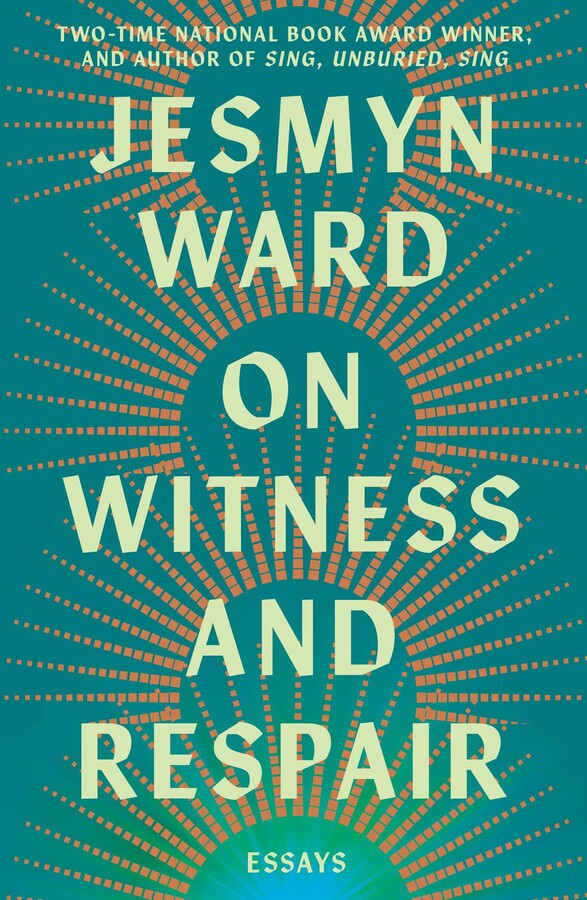
I am quite in awe of Ward’s talent and storytelling, and I take away so many nuggets of goodness and truth each time I spend time with her novels. From this book’s description:
Respair (noun, obsolete), fresh hope after despair.
From the two-time National Book Award winner and New York Times bestselling author Jesmyn Ward, this collection of essays documents more than a decade of work in the life of a singular writer often lauded as “the heir apparent to Toni Morrison” (LitHub). Beginning with her upbringing in a multigenerational household in rural Mississippi, the cradle of both her youth and her gift for storytelling, Ward brings her keen wisdom and hauntingly lyrical prose to a range of topics, following in her grandmother Dorothy’s footsteps when she promises always to “Tell it straight. Tell it all.”
True to her word, in these pages Ward contemplates the writers and novels of her youth and adulthood—the transformative power of discovering Octavia Butler as a twenty-something, the mirror that Richard Wright’s novels held up to her own childhood, and of course, her lifelong love for Toni Morrison. Ward ruminates on her approach to both fiction and life, reflecting on the power of the novel, how to raise a Black son in an era of rising divisiveness and cruelty, as well as her own personal tragedies—including the titular essay of the collection, which tells the story of her partner’s sudden death on the eve of the COVID-19 epidemic. Every bit as piercing and moving as her fiction, On Witness and Respair is a testament to Ward’s powers as “one of America’s finest living writers” (San Francisco Chronicle) and is a monument to hope, beauty, and personal and collective resilience.
When I initially read it, I almost missed that first part:
Respair (noun, obsolete), fresh hope after despair.
Respair…I am all about words, and had never heard of this one. Now, that is all I can think about.
Respair…Ward’s chosen word for processing sorrow and pain with resilience
Respair…That is the essence of Lauren’s heartfelt reflections.
Respair…a potential paradigm for living in families, communities, Mississippi, the United States, the world.
Respair…fresh hope after despair.
Now I am off to help make this beautiful word - and all it conveys - no longer obsolete.
Goodness, now I’m crying again. I’m so lucky to call you a neighbor. Thank you, friend. Solidarity. 🩷